The fashion industry of the UAE and Russia: cultural capital, competition, marketing, and new consumer identity.
In Short: What Fashion Brand Leaders Need to Know
• The Russian fashion market has grown in monetary terms, but decreased in units: in 2025, Fashion Compass estimates it at 3.94 trillion rubles (+6%), with a decrease in physical sales of 8–10%.
• 55% of fashion sales in Russia are already online, and 44% of the overall market is on marketplaces. This intensifies competition based on price, delivery time, and product visibility, not just brand.
• The UAE shows a different picture: fashion growth is supported by tourism, affluent expats, a strong retail infrastructure, and a design ecosystem. But UAE data shouldn't automatically be considered "Dubai data."
• The potential return of global brands is not a matter of a single date. We need to prepare for systemic competition: product, CRM, assortment planning, service, operational efficiency, and cultural distinctiveness.
• The main asset of a local brand is not a temporarily free shelf, but the reason why the customer will continue to choose it as the choice expands.
Introduction
I continue to explore the UAE fashion market, not as a tourist looking to compile a list of "places to visit," but as a marketer interested in something else: the way its own distinct taste system is gradually emerging. International luxury is readily apparent in Dubai—it's literally integrated into the city's infrastructure. But if you step outside the usual "mall-flagship-unpacking" route, a far more intriguing layer emerges: designer labels, small showrooms, regional platforms, pieces with intricate draping, architectural shoulder lines, and unconventional use of length, coverage, and body.
And herein lies a paradox. A real city offers colossal material for individuality, while its image on social media is often reduced to a very brief visual vocabulary: Cartier, the latest new phone, a car, a boutique box, a recognizable bag. This isn't an accusation of lack of taste or an attempt to dismiss expensive items as "too simple." High-status objects serve a clear social function: they are quickly perceived. This is precisely their power.
I'm interested in something else: why is demonstrating purchasing power almost always easier than demonstrating personal taste? And what happens to the market when a buyer lives for a long time in an environment where major international competition is temporarily weakened? For Russia, this question is no longer theoretical. After 2022, local brands received space they could previously only dream of: retail space, media attention, a new loyalty to the phrase "Russian brand." But four years later, the opposite has also become clear: vacated shelf space doesn't automatically translate into sustainable business.
My working hypothesis is simple: the long-term competitiveness of a fashion brand is determined not only by quality, price, distribution, and marketing budget. It is determined by the brand's ability to accumulate cultural capital—a recognizable design language, its own system of associations, and the customer's habit of seeking it out rather than the closest functional equivalent. In this sense, Dubai is a useful laboratory. It simultaneously demonstrates the power of global status symbols and how a unique design scene can grow alongside them.
01. The Dubai Almost Invisible Behind the Unboxings
There's a very simple reason why a logo beats a complex silhouette in the feed: a logo doesn't require deciphering. If the viewer knows the symbol, they understand the message in a split second. For an independent designer, it's the other way around. First, they need to notice the cut, then become interested in the brand, and then remember the name. In an algorithmic environment where people scroll through dozens of pieces of content per minute, this is a more costly path to attention.
It's important not to substitute this conclusion with the popular myth that "algorithms favor luxury." There's no reliable evidence to support this claim. However, there's a more general recognition economy at play. BoF and McKinsey noted that social media has already caught up with search engines as a channel for discovering fashion brands: 38% of shoppers reported discovering them through social media versus 37% through search engines. At the same time, choice is overwhelming: 74% of customers in the study said they abandoned an online purchase due to an excessive number of options. In such an environment, a familiar sign acts as a cognitive shortcut—not necessarily as a sign of better quality, but as a way to make a faster decision.[1]
This logic is particularly strong for the UAE, as digital isn't considered an "additional channel" there. Deloitte's Digital Consumer Trends 2025 study for the UAE and Saudi Arabia found that 73% of respondents had made at least one purchase through social platforms in the previous year. GWI's UAE study, based on a sample of 3,507 consumers aged 16-64, describes a market with very high social media usage and a pronounced optimism about personal finances.[2][3]
This leads to an important marketing implication. When consumption becomes public, the product serves two purposes: it benefits the owner and conveys a message to the audience. The faster the message is perceived, the greater its social "effectiveness." Research from 2024 demonstrates a link between influencer exposure, social comparison, FOMO, materialism, and conspicuous consumption. One study used a sample of 272 respondents on MTurk; another experimental study included 544 students in China and showed that the type and luxury of consumption influence envy and consumption intentions. These studies cannot be mechanically generalized to residents of Dubai or Russia, but they provide a good explanation of the mechanism: publicity enhances the comparative context, and a recognizable, status-based object facilitates comparison.[4][5]
Yet, to consider Dubai a city of mere ostentation is to view it through the most ostentatious part of the news feed. The physical space is far more interesting. Here, there's a customer accustomed to international service standards, a strong casualwear culture, a demand for modesty without visual poverty, a closed silhouette without sacrificing sexuality, fabrics that move gracefully, and pieces that can exist between daytime and evening contexts. It's precisely from these constraints that local design solutions emerge.
I think this is the main lesson of this first observation: taste doesn't develop because people reject well-known brands. It emerges when their field of choice expands and they develop the habit of distinguishing. Not "Cartier or an unknown designer," but the ability to understand why in one case you need a Cartier, and in another, an object whose value you have to explain to yourself, not to your followers.
02. How the UAE Is Building Its Own Fashion Industry
Today, it's more accurate to talk about "Dubai fashion" not as a set of aesthetic images, but as an infrastructure. The city boasts the Dubai Design District, an official Dubai Fashion Week, a network of international buyers, major luxury retailers, e-commerce, tourism, and access to audiences across the GCC. Dubai Fashion Week is jointly developed by d3 and the Arab Fashion Council. For the AW 2025/26 season, organizers announced more than 25 designers from various countries; Vogue later counted 35 designers and 17 countries represented. DFW has a Buyers Program that connects designers with international buyers, and the fashion week itself intentionally schedules its dates before New York, London, Milan, and Paris.[6][7]
This is important because the fashion industry doesn't thrive where there are a lot of well-dressed people, but where talent can navigate the chain of "idea—production—show—buyer—publication—repeat order." A beautiful show, without commercial follow-up, remains a cultural event. Dubai is gradually building this chain.
The economic foundation for this is unusually favorable. According to the Dubai Department of Economy and Tourism, the city welcomed 19.59 million international overnight visitors in 2025—a 5% increase from the previous year. The population of the emirate itself reached 4.58 million by the end of 2025, an increase of 7.5% over the year; during the daytime, taking into account transients, the number of people in the city was estimated at 6.392 million. It's a market in which regular shoppers constantly mix with tourists, expats, business guests, and affluent transit customers.[8][9]
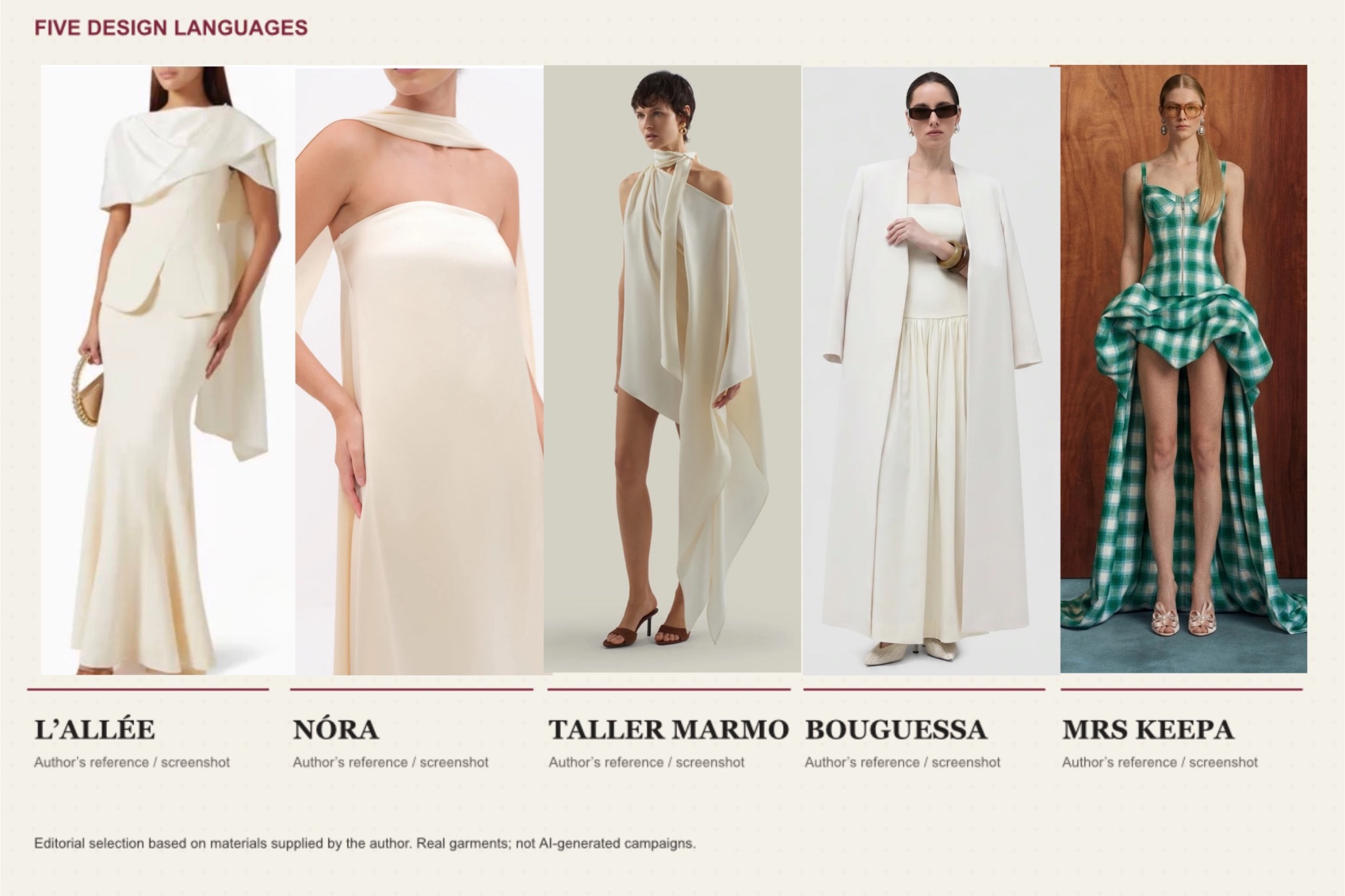
Euromonitor estimated the UAE apparel & footwear market at AED 66.8 billion in 2025, up 5% year-on-year in retail value, and attributes the growth, among other things, to tourism and disposable income. It's important not to substitute Dubai for the UAE: this is a country-specific indicator, not a city-specific one. Another common mistake is to take the entire Middle East and label it as the UAE. For example, Bain, via Reuters, estimated luxury sales in the Gulf at $12.8 billion in 2024, up 6% year-on-year; tourists account for approximately 50–60% of the region's luxury sales. This provides useful context for the GCC, but it doesn't represent Dubai or the UAE.[10][11]
It's significant that the Dubai Design District and BoF released a separate white paper in 2025 on the city's fashion opportunities, based, among other things, on a survey of over 1,000 Dubai residents. The very existence of such a study is significant: the city is marketing not only consumption but also itself as a platform for creating and scaling brands.[12]
That said, we shouldn't romanticize the system. It's very expensive to make mistakes in Dubai. Attention, rent, content production, retail presence, and international service are all expensive here. But that's precisely why the market is so good as a stress test: a weak brand can buy a beautiful shoot, but it's harder for them to endlessly subsidize the lack of product, a coherent collection, or repeat purchases.
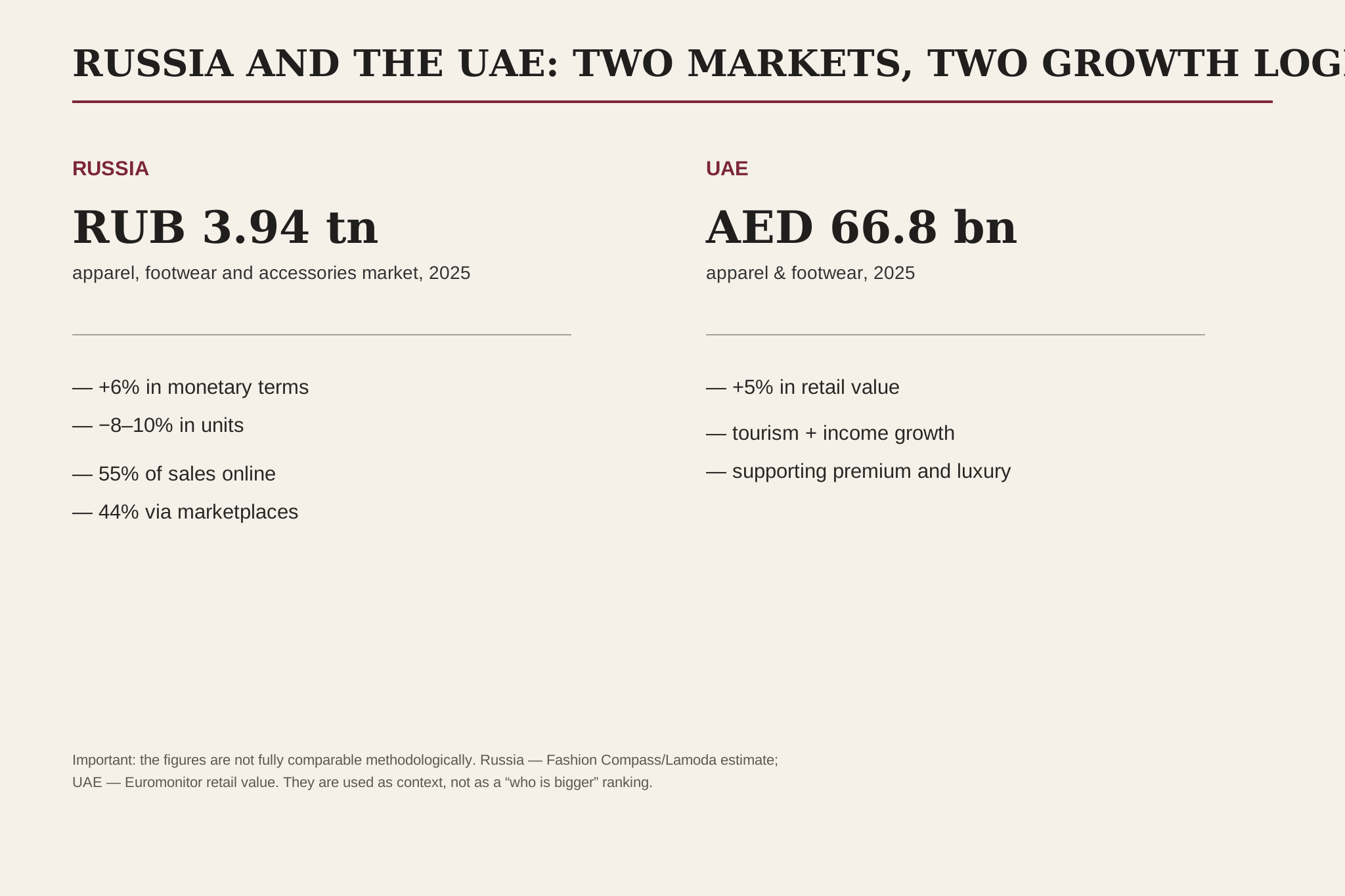
From a strategic perspective, the UAE is interesting because localization here doesn't equate to folklorization. A good regional brand doesn't have to imprint its "cultural code" on every garment. It can work much more subtly—through length, the flow of fabric, the degree of skin exposure, the architecture of the kaftan, its evening functionality, and its approach to color and rich texture. This is precisely what's evident in the brands I've selected for this visual analysis.
03. Five Design Languages of Contemporary Dubai
It's important to clarify geography here. Not all brands that sell actively and have a visual presence in Dubai are Emirati. This is a crucial part of the study: the local fashion market consists of homegrown labels, regional designers, and international brands that have found a natural audience here.
L'ALLÉE . The brand works with asymmetry, draping, complex shoulders, and elongated eveningwear. On Ounass, Lallee's assortment ranges from approximately AED 650 to AED 3,185, with the bulk of the notable line consisting of dresses and casualwear. However, the brand itself is not Emirati: the official L'ALLÉE Design website links it to designer Huyen Pham and a history that began in 2016. Dubai has a knack for importing not only international luxury but also more niche design idioms.[13][14]
NÓRA . The pieces are built on a soft architecture: the cape becomes part of the top, the draping simultaneously covers and accentuates the figure, and ivory functions not as a wedding color but as a neutral base. On the official website, the Avery Draped Top & Skirt Set in Naia Satin costs AED 1,260; the brand offers try-on in the Dubai showroom, same-day delivery within the UAE, and international shipping. In its holiday collection, NÓRA explicitly states that the pieces are crafted in Dubai. This is no longer just an aesthetic consideration, but a competitive advantage of operational proximity to the customer: a local premium can give customers a speed that an international niche brand can't always match.[15][16]
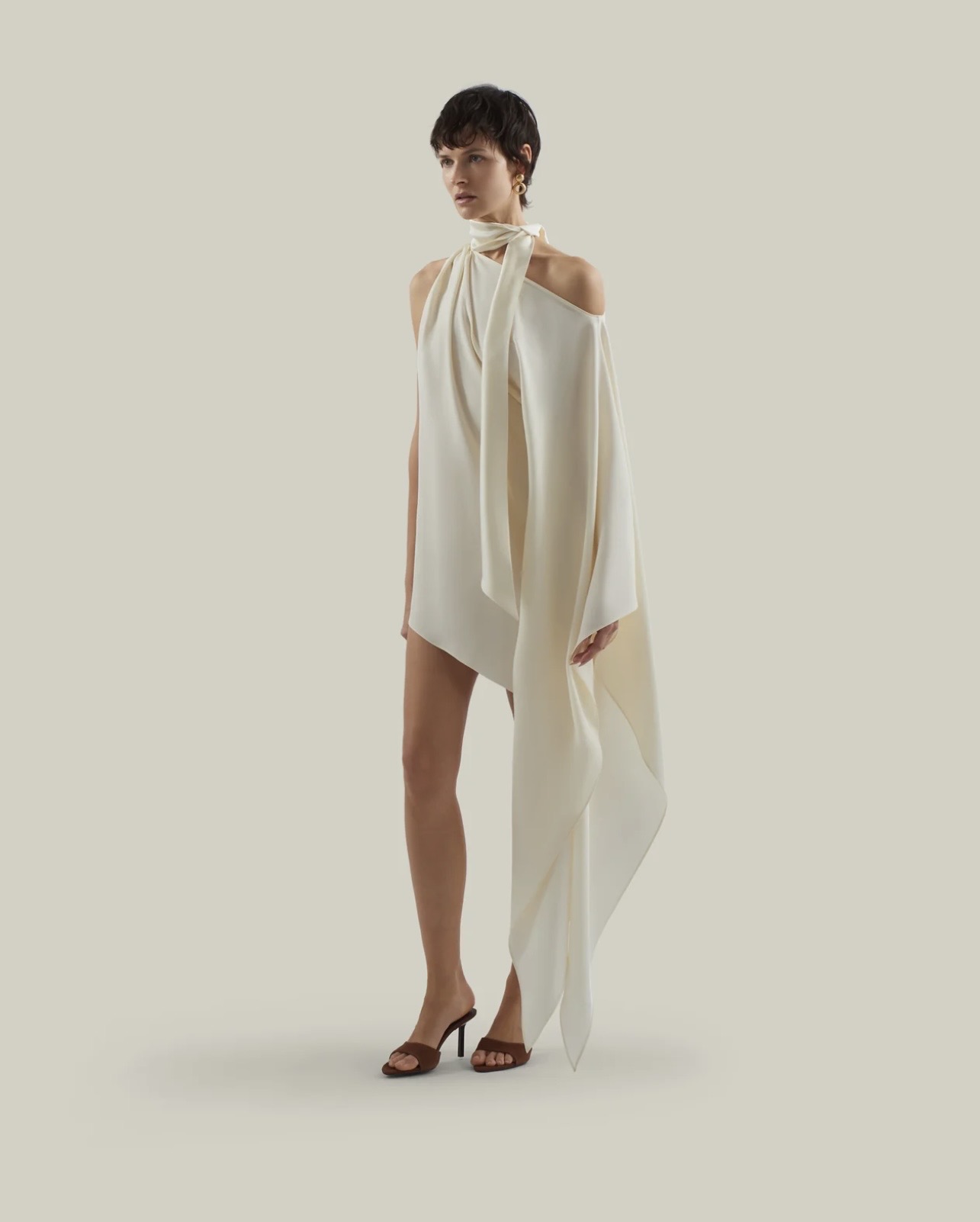
Taller Marmo is a particularly good example of why a brand's origins can't be summed up in a single line. Riccardo Audisio and Yago Goicoechea founded the label in 2013, starting in Dubai; today, the company describes itself as a Milan-based fashion house, with production and identity strongly tied to Italy. At the same time, the founders themselves have repeatedly cited Dubai as the place where the brand's language was formed: fluid kaftans, controlled opulence, European evening culture adapted to Middle Eastern freedom of volume. This is a truly transnational brand, for which Dubai was not a market after the product, but part of the product's origin.[17][18]
Bouguessa . The language here is almost the opposite: minimalism, line, geometric precision, and formal outerwear. Faiza Bouguessa founded the brand in Dubai in 2014; the studio is located in the Dubai Design District, and the brand releases three collections a year. Bouguessa himself formulates his inspiration through art, architecture, and contemporary design. Visually, the long jackets and coats are particularly interesting: they convey authority without the need for a traditional men's suit. For the regional market, this is a strong move—modesty here becomes not a constraint, but a tool for monumentality.[19]
Mrs. Keepa . Founded by French-Egyptian designers Mariam Yeya and Bassel Komaty, the brand has been around since 2016 and is based in the Dubai Design District. Its DNA is more eclectic, vintage, and artistically inspired than Bouguessa's: large volumes, unexpected prints, complex styling, and the ability to wear a piece in multiple ways. In 2024, Mrs. Keepa collaborated with Sotheby's Dubai, and the brand itself is a regular participant in Dubai Fashion Week. This is an example of how a local brand can build cultural legitimacy not only through influencers but also through institutional alliances.[20][21][22]
What unites these five languages? Not a single "Arabic style." Rather, it's a rejection of overly simple clothing as the sole language of modernity. There's a lot of fabric. A lot of movement. Often, there's a sense of presence—a garment is noticeable even without a large logo. At the same time, the price isn't always ultra-luxury: some brands are in the accessible premium zone, where the buyer pays not for a world-famous logo, but for expressiveness and limited availability.
For a marketer, this is an important distinction. If a brand is unknown, it needs to compensate for its lack of symbolic capital with either product innovation, cultural context, service, or community. It's difficult to win with a "quality base" alone against an international system that creates a quality base at scale.
04. Russia’s Fashion Market After 2022: Four Years Without Familiar Competition
The Russian market after 2022 faced a rare situation: competition hadn't disappeared, but its nature had changed. Many international players had left or suspended direct operations; space had become available; shoppers were increasingly looking to local brands; retailers and shopping centers began actively filling vacant spaces with Russian and emerging international brands. For the first two years, this seemed like a window of opportunity. By 2025–2026, it became clear that this window of opportunity didn't negate the laws of unit economics.
Lamoda's Fashion Compass, based on data from the platform itself, Fashion Consulting Group, Data Insight, Focus Technologies, B1, and in-depth interviews with market participants, estimates the Russian clothing, footwear, and accessories market by the end of 2025 at 3.94 trillion rubles—+6% in monetary terms. However, in physical terms, sales declined by 8-10%. This is a near-perfect illustration of why revenue growth cannot be automatically interpreted as an increase in the industry's health: part of the dynamics are explained by prices, and consumers are physically purchasing fewer items. The share of online sales reached 55%, with marketplaces accounting for 44% of the entire fashion market.[23]
Now comes the worst. In 2025, according to CORE.XP, approximately 20 Russian fashion brands completely closed their stores; according to different consultants, the number of closing and exiting brands varies depending on the methodology. NF Group reported 12 fashion brands that left the market between January and September 2025, including both Russian and foreign brands, while Nikoliers reported 17 domestic brands since the beginning of the year. For us, it's more important not to pick a single "magic" figure, but to demonstrate the scale of the reversal and accurately identify the methodology.[24][25]
In Moscow shopping centers, fashion accounted for 50% of all closures in Q3 2025, 12 percentage points more than the previous quarter. CORE.XP attributed this to the strengthening of online channels, consumer savings, and a review of chain strategies. In early 2026, market representatives estimated the number of fashion store closures by 2025 at 400–500 nationwide, including chain optimization, not just the complete disappearance of brands. Concurrently, vacancy rates increased, and lease negotiations intensified.[26][27]
The reasons are quite mundane: the high cost of physical retail, taxes, utility and logistics expenses, the complexity of importing, expensive money, rising production costs, pressure from marketplaces, and a decline in consumer willingness to pay a premium simply for a brand's presence in a shopping center. Importantly, some brands haven't "died" but have migrated online. So, closing a store doesn't always mean closing a business; sometimes it's an admission that the offline unit isn't working.
And here I would be especially cautious when using the phrase "Russians have become poorer." Rosstat, on the contrary, estimated real income growth in 2025 at 8.5%. But consumer sentiment could deteriorate even with rising average real incomes: income distribution, inflation expectations, interest rates, and a sense of uncertainty are all important. At the beginning of 2026, the Bank of Russia recorded household inflation expectations at 13.7% and a decline in the consumer sentiment index. In other words, macroeconomic statistics and subjective caution could move in different directions.[28][29]
What else has changed over these four years? The marketplace has become more than just a sales channel, but a competitor for the brand's very logic. With 44% of fashion purchases happening through universal marketplaces, consumers are becoming accustomed to comparing cards, discounts, delivery times, and reviews faster than values, collections, and cultural context. For manufacturers, this creates a dangerous trap: they can quickly increase turnover while simultaneously training customers to forget their name.
In this sense, the Russian market is currently at a crucial juncture. Local brands have acquired something they previously lacked in such large quantities: brand recognition, prime locations, scaling experience, a dedicated audience, and customer data. But if these four years have been spent solely on expanding product ranges and opening stores, rather than building distinctiveness and operational discipline, the return of stronger competition will be painful.
05. What Happens If International Brands Return?
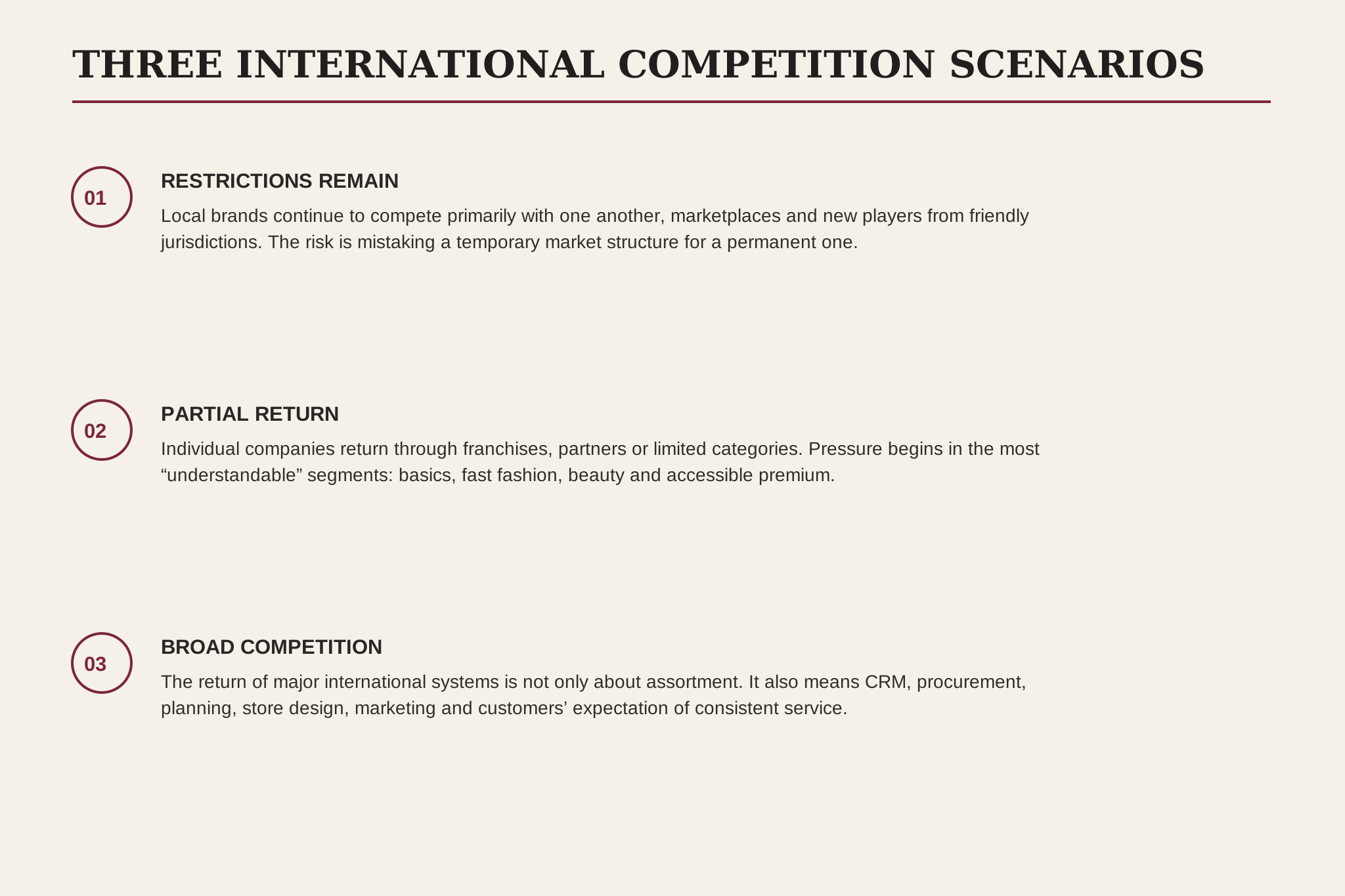
I'm deliberately formulating this section as a scenario, not a forecast. As of September 2026, there's no factual basis for writing that Zara, IKEA, or the major luxury groups are "about to return." Moreover, foreign policy and sanctions restrictions remain significant, and IKEA's official website explicitly states that retail operations in Russia have ceased and the company no longer conducts retail business there. LVMH closed its luxury stores after 2022; Reuters reported in 2026 that the group retained its Belmond asset in Russia, but this doesn't mean a recovery in fashion retail. Therefore, it's more useful not to speculate on a date, but to test the resilience of Russian brands against three possible scenarios.[30][31]
Scenario 1: Restrictions remain in place. At first glance, this seems like the most convenient option for local players. However, it carries the risk of complacency. Even without Zara, the Russian brand is already competing with marketplaces, Turkish, Chinese, and other foreign brands, parallel imports, and global content. Consumers don't live in cultural isolation: they still compare products with what they see on trips, social media, and in foreign online stores.
Scenario 2: Individual companies or categories return. This may not be a literal reopening of the same chain, but a franchise, a partnership model, a limited assortment, specific beauty or home categories, or a new ownership structure. This scenario is dangerous because the pressure will be uneven. A brand may consider itself protected until an international player returns to its price range.
Scenario 3: Broader international competition is restored. Here, Russian players will face systems rather than "branded T-shirts." Zara's strengths lie primarily in the speed of sales analysis, assortment planning, logistics, merchandising, and the habit of updating its stores. IKEA isn't a fashion competitor, but it's a very useful analog: its strength has historically been its ability to combine product, price-value, navigation, service, visual appeal, and a clear lifestyle into a single product. International luxury, in turn, will compete for cultural status, high-spending customers, editorial attention, and prime locations.
The biggest mistake is to prepare for such a comeback by lowering prices. A Russian brand will almost certainly lose to global fast fashion in terms of economies of scale, and luxury in terms of accumulated symbolic capital. Therefore, winning must be in areas where scale doesn't automatically provide an advantage: the speed of local solutions, customer knowledge, service, limited drops, product signature, local collaborations, cultural affinity, and community.
There's another important context: the global giants themselves aren't in ideal shape. McKinsey described 2025 as a period of low growth for fashion, and noted a slowdown and a limit to price-driven growth in luxury: over 80% of luxury's growth in the previous period was driven by price, not volume. In 2026, Reuters continued to describe pressure on luxury groups and the battle for customers. That is, a potential competitor may be strong, but it too is forced to re-prove its value.[32][33]
This changes the conversation. A Russian brand doesn't need to become "our Zara" or "our The Row." It's far more important to understand its own indispensability. If a customer can easily replace your product with an international equivalent, the problem isn't that the global brand has returned. The problem was that before its return, you hadn't yet become a choice, but remained an affordable alternative.
06. Independent Taste as a Competitive Advantage
At the end of this study, I return to where I started: taste. In marketing, this word often sounds too subjective, so it's avoided. But the business impact of taste is quite measurable. When a brand has a recognizable decision system, the likelihood that a buyer will search for a specific brand rather than just a "white dress" increases. Substitutability decreases. Branded search increases. Organic editorial value emerges. Collaborations become more meaningful because the brand brings not only its audience but also its own perspective to the partnership.
Cultural capital in fashion isn't a collection of famous names surrounding a brand. It begins much earlier. With research into the customer's lifestyle and the tensions present in their wardrobe. With a design language that's repeated consistently enough to become a code. With positioning that helps eliminate unnecessary assortment. With a content system where the product exists within a world, not an endless "model against a gray background" shoot. With partnerships with art, architecture, theater, and design—but only when they support the brand's vision. With a community that empowers the customer as more than just a buyer.
This, in my view, is where the new luxury lies—not in the rejection of expensive items or the moralizing slogan "logos are no longer important." They are important. Recognition is important in general. But the real scarcity today isn't access to recognizable things, but the ability to find something interesting before it becomes obvious to everyone.
This is independent taste: not demonstrative originality for the sake of originality, but a developed ability to choose. For an individual, this is a cultural advantage. For a brand, it is an economic one.
Because in a world where product selection will once again be vast, marketplaces even faster, and international brands potentially closer, you can't compete endlessly with just "we have that jacket too." You need to make sure customers understand why this jacket is yours.
If you're tempted to do just one thing after this article, I'd suggest not building another moodboard folder full of global trends. Open your own collection and ask the team a more challenging question: if you remove the logo, signature, and advertising, what's left that's recognizable as us?
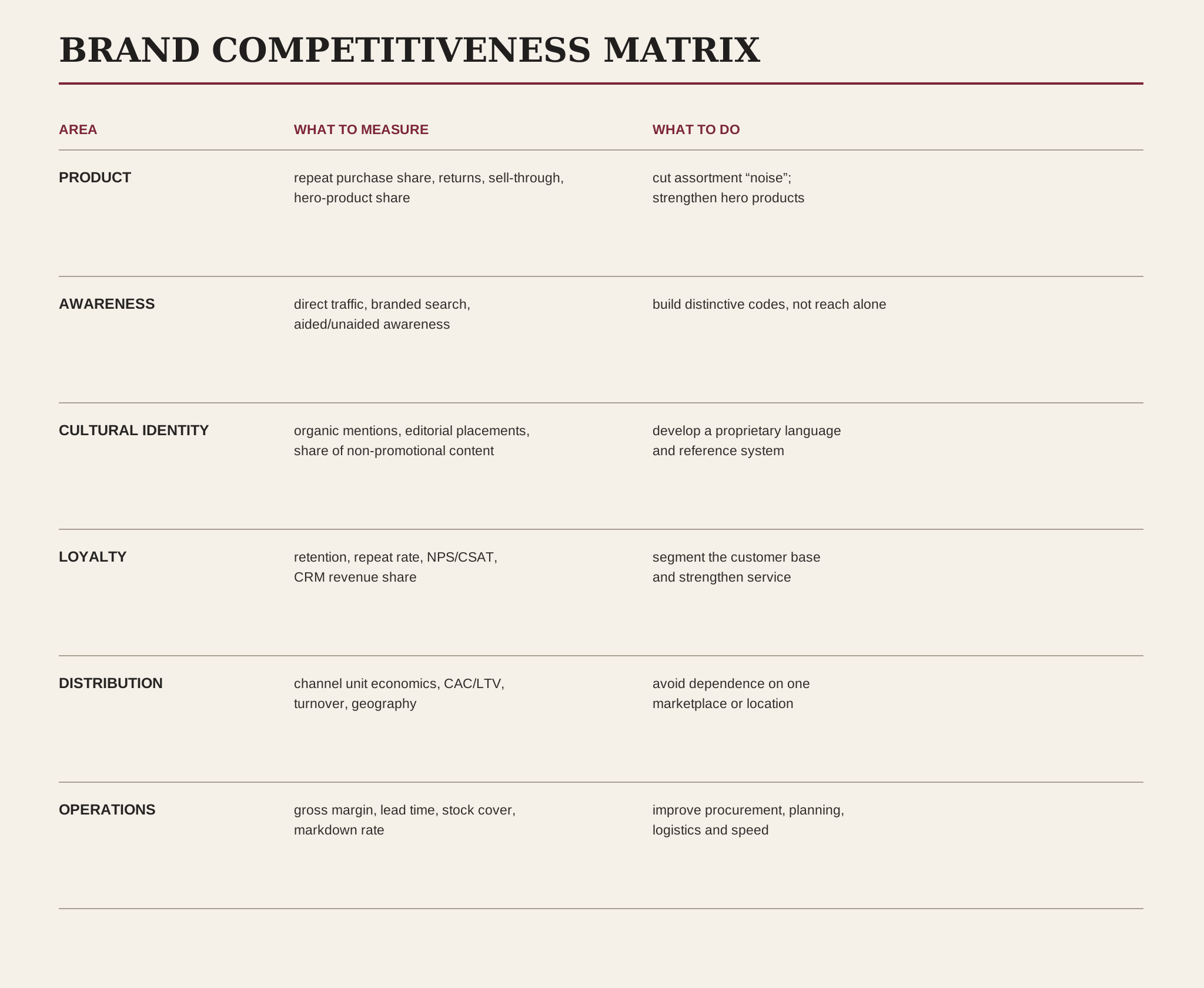
Practical Tool 1. Brand Competitiveness Matrix
The matrix below intentionally avoids providing "scores" for real brands. Its purpose is to transform the discussion of brand strength into an operational audit. For each area, a set of metrics is needed, not just the manager's perceptions. Product — sell-through, returns, repeat purchases, share of hero SKUs. Awareness — branded search, direct traffic, aided and unaided awareness. Cultural identity — organic editorial mentions, share of non-promotional content, presence of consistent visual codes. Loyalty — retention, repeat purchases over 90/180/365 days, share of CRM revenue. Distribution — channel unit economics and dependence on a single intermediary. Operations — gross margin, lead time, turnover, markdown rate, planning accuracy.
The purpose of the matrix is to identify where a brand is only visually strong. For example, high awareness with low retention may indicate expensive media exposure without a buying habit. A large marketplace with weak direct traffic may indicate a dangerous dependency. A highly recognizable aesthetic with chronic out-of-stock behavior may indicate creativeness without the operational ability to monetize demand.
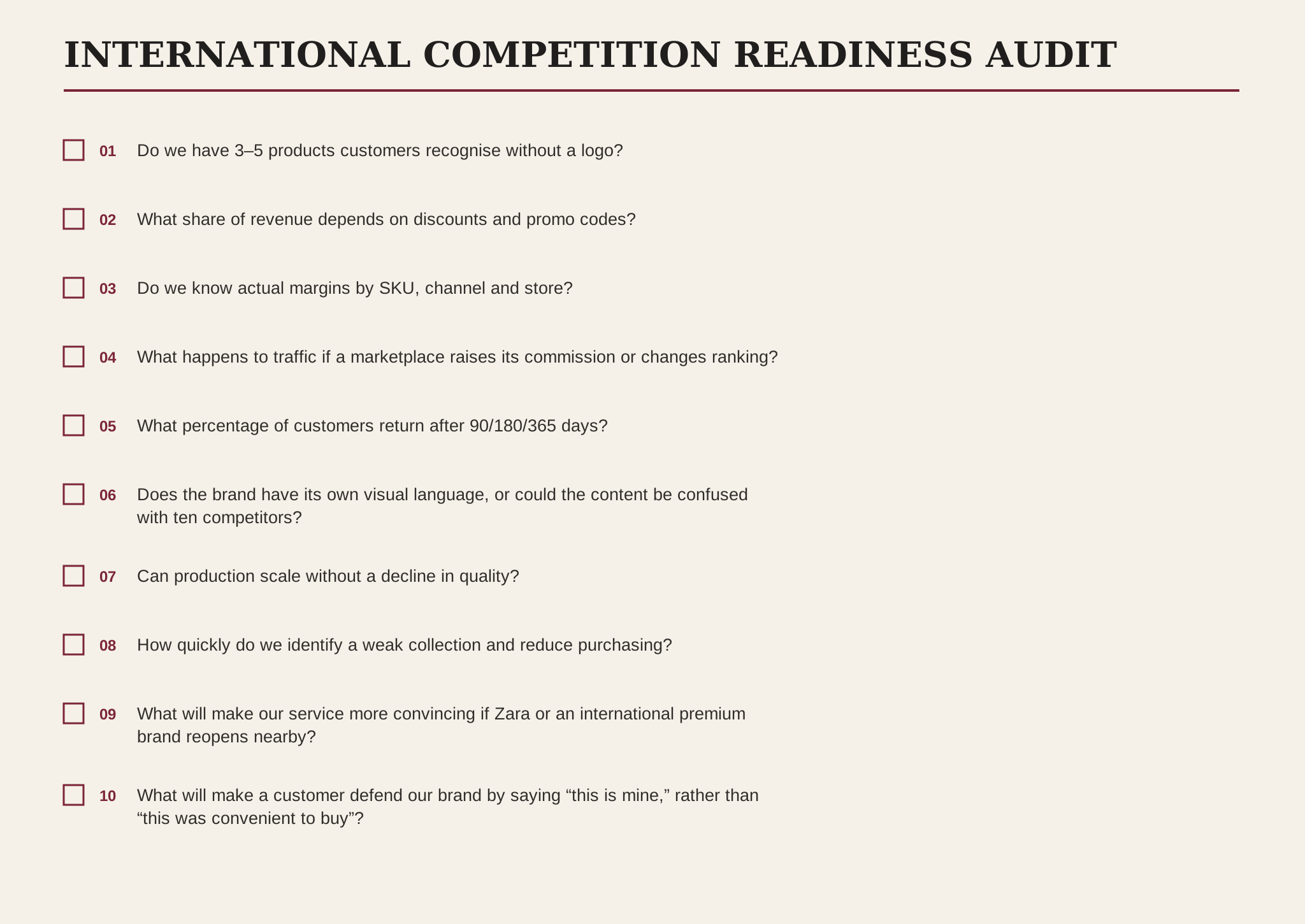
Practical Tool 2. International Competition Readiness Audit
The checklist shouldn't be taken as a yes/no test, but as a reason to gather data. Each answer should be supported by evidence: a report, metrics, customer interviews, store P&L, or product analytics. If the team answers, "We're loved for our quality," the next question is how this manifests in behavior: fewer returns? Higher repeat rates? Higher willingness to pay? Less markup? If the answer is, "We have a strong community," how much revenue do members generate, how often do they return, do they create organic content, and do they attend events without a discount incentive?
The main goal of the audit is to identify advantages that will not disappear even as the external environment changes. A location temporarily vacated by an international brand's departure is not an advantage. A recognizable product, a repeat customer base, an independent direct channel, a strong gross margin, and a flexible supply chain are advantages.
Practical Tool 3. From Product to Cultural Capital
It’s better to build the sequence here not through “first a beautiful brand book,” but through seven steps.
The first is audience research: not demographics, but contexts of use, tensions, open scenarios, the client’s language.
The second is the design language: 3–5 repeatable principles of form, material, color, or construction.
The third is positioning: what alternatives does the brand deliberately reject?
The fourth is the content system: themes, formats, and visual rules that explain the product without a permanent discount.
Fifth, cultural partnerships: institutions and authors who have semantic compatibility.
Sixth – community and service: the mechanics of customer participation after purchase.
The seventh dimension is: brand search, retention, earned media, organic mentions, price realization, share of full-price sales.
Cultural capital is a slow-moving asset. It can't be "launched" with a campaign in a month. But that's precisely why it's valuable: a competitor can copy the price, a similar style, or even the location. It's much more difficult to copy a customer's accumulated system of associations and their habit of seeing the world through a specific brand's lens.
Bibliography and Sources
- [1] BoF / McKinsey, “Fashion's New Era of Product Discovery,” 12/04/2024.
- [2] Deloitte Middle East, Digital Consumer Trends 2025, UAE & KSA.
- [3] GWI, UAE Consumers report, sample 3,507 consumers aged 16–64.
- [4] Heliyon, Social media influencers and followers' conspicuous consumption, 2024, n=272.
- [5] BMC Psychology, How social media sharing drives consumption intention, 2024, n=544.
- [6] Dubai Fashion Week, AW 2025/26 global line-up, 01/19/2025.
- [7] Vogue, “3 ways Dubai Fashion Week is putting itself on the map”, 02/10/2025.
- [8] Dubai DET, Tourism Performance Jan–Dec 2025.
- [9] Emirates News Agency / Digital Dubai, Dubai population at end-2025.
- [10] Euromonitor, Apparel and Footwear in the UAE, 2025.
- [11] Reuters citing Bain, Middle East luxury sector, 06/26/2025.
- [12] Dubai Design District / BoF, Inside the Fashion Opportunity in Dubai, 2025.
- [13] L'ALLÉE Design, official brand story.
- [14] Ounass UAE, Lallee assortment and prices, accessed 2026.
- [15] NÓRA, Avery Draped Top & Skirt Set, official product page.
- [16] NÓRA, Festive Collection, official site.
- [17] The National, Taller Marmo founders and Dubai origins, 10/15/2023.
- [18] GQ Middle East, Taller Marmo Writes Its Menswear Chapter, 03/07/2025.
- [19] Bouguessa, official About page.
- [20] Mrs Keepa, official About page.
- [21] Sotheby's Dubai, Inside The Style of Mrs Keepa's Timeless Couture, 02.02.2024.
- [22] Dubai Fashion Week, Mrs Keepa profile.
- [23] Lamoda / Fashion Compass 2025, published 2026.
- [24] Vedomosti / CORE.XP & IBC Real Estate, brand closures in 2025.
- [25] Interfax / NF Group and Nikoliers, exits in 2025.
- [26] CORE.XP, Fashion formed 50% of closures in Moscow malls, Q3 2025.
- [27] The Moscow Times citing CORE.XP, 2025 store closures, 01/09/2026.
- [28] Rosstat, household income; 2025 real money income +8.5% estimate.
- [29] Bank of Russia / InFOM, inflation expectations and consumer sentiment, 02/03/2026.
- [30] IKEA, official position on Russia, accessed 2026.
- [31] Reuters, LVMH Russia operations context, 02.27.2026.
- [32] McKinsey, The State of Luxury Goods in 2025.
- [33] McKinsey, The State of Fashion 2026.
The primary dataset is from 2024 to 2026. Earlier data is used only where necessary to confirm the brand's history. Dates and geography are provided in the text; for studies with a sample, available sample characteristics are provided.
Editorial note: Market estimates from different research companies may vary due to the categories, channels, and methodology covered. This article does not summarize them into a single, unambiguous figure.