
A small business does not suffer from having ‘too little marketing’. It suffers because limited resources do not forgive the mistakes a large company can survive. A limited budget is not a smaller version of marketing. It is marketing with a high cost of error.
Do not do the same thing, only cheaper
A large brand can fund several channels, test five creative concepts, survive a failed production and still buy enough reach to remain visible. A small business has no such luxury. ‘Do the same thing, only cheaper’ is therefore one of the most expensive pieces of advice it can receive.
The more useful question is this: when money is scarce, which parts of the marketing system must not be compromised, which can be replaced with time and expertise, and which should be removed altogether?
The first mistake is cutting everything proportionally
When a budget is halved, the instinct is to halve every line: less content, less PR, less targeting, cheaper design and fewer newsletters. The business preserves all the complexity of the marketing system while depriving every element of the minimum power it needs to work.
In 2026 WARC and CreativeX analysed more than 633,000 ads. Content output rose by 29%, while media support per ad fell by roughly 15%. Ninety-three per cent of ads received less than $10,000 in support yet absorbed around 30% of total spend. The industry is producing more units of communication than it can properly fund.
The conclusion for a small brand is severe: it cannot afford content inflation. Ten weakly supported initiatives are almost always worse than one idea given enough time and money to accumulate an effect. Under scarcity, do not cut the quality of every element. Cut the number of elements.
Start by locating the business constraint
A marketing task should begin not with a channel — ‘we need Telegram’, ‘let’s use creators’, ‘we need social media’ — but with the constraint holding the business back.
Four situations are frequently confused. Almost nobody knows the brand: the problem is access to new audiences and mental availability. People know the brand but do not understand why they need it: the problem is the offer and positioning. Interest exists but purchase does not happen: the problem sits closer to product, price, trust, distribution or conversion. People buy once and do not return: the problem is product, experience and repeat purchase, not a shortage of new posts.
If the diagnosis is wrong, a small budget runs out before the business learns what failed.
Nielsen exposed a revealing gap: 84% of marketers felt confident in their ability to measure ROI, yet only 38% measured traditional and digital investment together. Seventy per cent intended to prioritise performance even while naming long-term and full-funnel ROI among their main KPIs. What is easy to measure can start to replace what is effective. The thing a business can measure quickly is not necessarily where it needs to invest now.
Buy an asset before you buy a channel
A small brand rarely has enough money to keep buying attention indefinitely. Part of its budget must therefore become an asset that continues to work after it has been paid for.
Such assets are practical: a clear architecture of the offer; language repeated consistently by the founder, sales team and website; recognisable visual and verbal devices; an owned contact base; cases and proof; searchable expert content; a partner network; and a communication format that can be repeated without being reinvented every Monday.
Positioning is valuable not as an elegant strategy document, but when it reduces the cost of future decisions: faster briefing, more recognisable advertising, fewer pointless creative iterations, clearer rejection of irrelevant channels and a stronger explanation of why the customer should choose this product.
It is better for a small business to pay once for a system that reduces the cost of its next hundred communications than to pay a hundred times for communications produced without a system.
Creative is not decoration. On a small budget, it is financial leverage
Creative is often treated as the last line in a constrained budget: buy reach first, then think about the idea if anything remains. The evidence suggests this is a dangerous order.
Kantar calls creative quality the second most powerful driver of advertising profitability after brand size — and the most important factor under a marketer’s control. In a joint Kantar and WARC analysis of roughly 450 cases, the ads with the strongest short- and long-term creative effectiveness generated more than four times the profit.
This matters especially to a small business. Brand size may be the strongest factor, but it cannot be changed today. Media volume is limited. The quality of the idea is therefore one of the few levers with which a smaller player can compensate for part of the inequality. A small budget does not make creative less important. It makes mediocre creative more expensive.
Before paying for distribution, a team should be able to show that the message solves the task. Can the idea be retold in one sentence? Is the brand recognisable without the logo at the end? Is there a reason to stop? Does the idea survive a change of format? If not, additional reach only scales the weakness.
Reach: there are no miracles here
The uncomfortable truth is that some constraints cannot be compensated for by intelligence. Fast mass reach costs money.
Ehrenberg-Bass research, extended into B2B categories by the LinkedIn B2B Institute, links sustainable growth to penetration and the acquisition of new buyers. Loyalty alone cannot create endless growth. The 95–5 principle also matters in B2B: at any given moment, most potential buyers are not actively looking for the product.
A strategy focused only on hot demand has a ceiling. Performance captures existing demand well, but does not create enough future demand. Binet and Field recommend balancing long-term brand building and short-term activation approximately equally — not as a universal accounting rule for every startup, but as a reminder that the bottom of the funnel cannot replace the top.
With little money, the answer is not to scatter it across mass reach. It is to choose a sufficiently narrow market in which the available budget can still create a noticeable share of voice.
Not one audience, but a market you can afford to cover
Narrowing an audience should not end with an attractive persona slide. It should define a field in which the business can create repeated contact.
A restaurant with one address does not need to compete for the attention of an entire city. A B2B consultant does not need the whole entrepreneurial internet. A new cosmetics brand does not need to speak to ‘all women aged 25–45’. The boundary can be geography, a professional community, a consumption occasion, a cultural context or a specific category entry point.
A better question than ‘who is our target audience?’ is: where is a market valuable enough for us, yet narrow enough for our current budget to make us visible more than once? Repetition is what separates strategy from a one-off success.
Three kinds of money: infrastructure, experiment and scale
A practical problem with small budgets is that all expenditure sits in one pile. The brand either tests forever or scales something before it has proved viable.
Infrastructure is what the system cannot function without: basic analytics, a website or conversion point, core brand assets, CRM or an owned database, product materials and minimally sufficient production.
An experiment is a limited sum the business is prepared to lose in order to answer a defined question. Not ‘let’s try creators’, but ‘does this type of creator generate qualified demand more cheaply than our current alternative?’ One test, one hypothesis and a stopping rule defined in advance.
Scale is the money given to a mechanism that has already proved itself. If the combination works, it does not need to be replaced immediately for the sake of variety.
WARC’s Effectiveness Code analysis of 4,863 cases warns against fragmenting resources across many small campaigns. Stronger outcomes are associated with adequate duration, media support and creative commitment to one platform. A small budget should buy information faster than it buys reach — and reach only once there is something worth scaling.
How to test when proper research is unaffordable
‘We have no research budget’ often means ‘we will decide without data’. There is a large territory between expensive research and intuition.
Interview 10–15 people across three groups: bought, nearly bought and declined. Look for repeated language and barriers rather than percentages. Examine your own sales: where the most profitable customers came from, what they buy again, where the sales cycle is shorter and what questions appear before purchase.
Use sales and customer support as a research function. Do not test five variables at once: change the offer, audience or creative around one key hypothesis. Define kill criteria before launch — an unacceptable cost per lead, sale or qualified contact, and the volume of evidence after which the experiment stops.
A small business may not be able to afford perfect statistical purity, but it can afford not to repeat the same mistake.
Owned, earned, borrowed, paid: cheap marketing does not begin with free
It is more useful to divide distribution into four types than into ‘paid’ and ‘free’.
Owned is what the business controls: customer data, website, newsletter, communities and CRM. Earned is attention that must be deserved: PR, recommendations, organic mentions, publications and discussion. Borrowed is someone else’s assembled audience: partnerships, collaborations, speaking, guest content and expert communities. Paid is speed and controlled distribution.
WARC’s 2025 review of low-budget marketing identifies earned media through PR, partnerships and shareable content among the key routes to better returns. But earned attention does not arise simply because money is absent. It arises when the business has a story, data, conflict, access, expertise or action that matters to someone other than the business itself.
Partnerships: value the exchange of assets, not the barter price
‘Do collaborations’ is useless advice until both sides can name what they bring to the exchange.
One partner may have an audience and the other a physical space. One has a product and the other the trust of a professional community. One has a strong news hook and the other distribution. A good collaboration grows not from friendship between brands but from complementary assets.
Before proposing a partnership, make two lists: what do we own that is expensive or difficult for the partner to obtain, and which scarce partner asset could replace our cash expenditure? If both lists are empty, this is not a partnership but a request for a free service.
Where not to economise
Do not economise on the point that creates trust in your category. For a premium product, this may be visual execution. For a financial service, evidence and reputation. For a restaurant, the product and the experience on site. For B2B, cases, competence and the quality of commercial materials. For e-commerce, the product page, reviews, logistics and a clear conversion path.
You can reduce production frequency, channel count, format variety and team size. Cutting the category’s primary signal of quality is dangerous: marketing will simply bring more people to weak evidence.
‘Shoot it on a phone’ is as poor a universal rule as ‘you need an expensive production’. The question is not the price of the image, but whether visual quality is part of the reason to trust and pay in this category.
What to buy from a specialist when you cannot afford ‘everything’
A small business should buy priority rather than volume. A strong external specialist is most valuable where an error would multiply downstream. It may be more rational to buy diagnosis and architecture than thirty weekly pieces of content: identify the constraint, shape the offer, choose the market, build the message system, create one strong creative platform, set evaluation criteria and teach an internal person to reproduce the system.
Conversely, there is little point buying strategy if nobody inside the business can execute it. The first hire may need to be an operational specialist who creates regularity rather than another consultant.
The useful question for a supplier is not ‘what can you do for this amount?’ but ‘what single change to our system will create the greatest effect within this constraint — and what will we be able to do ourselves afterwards?’
The crisis budget matrix
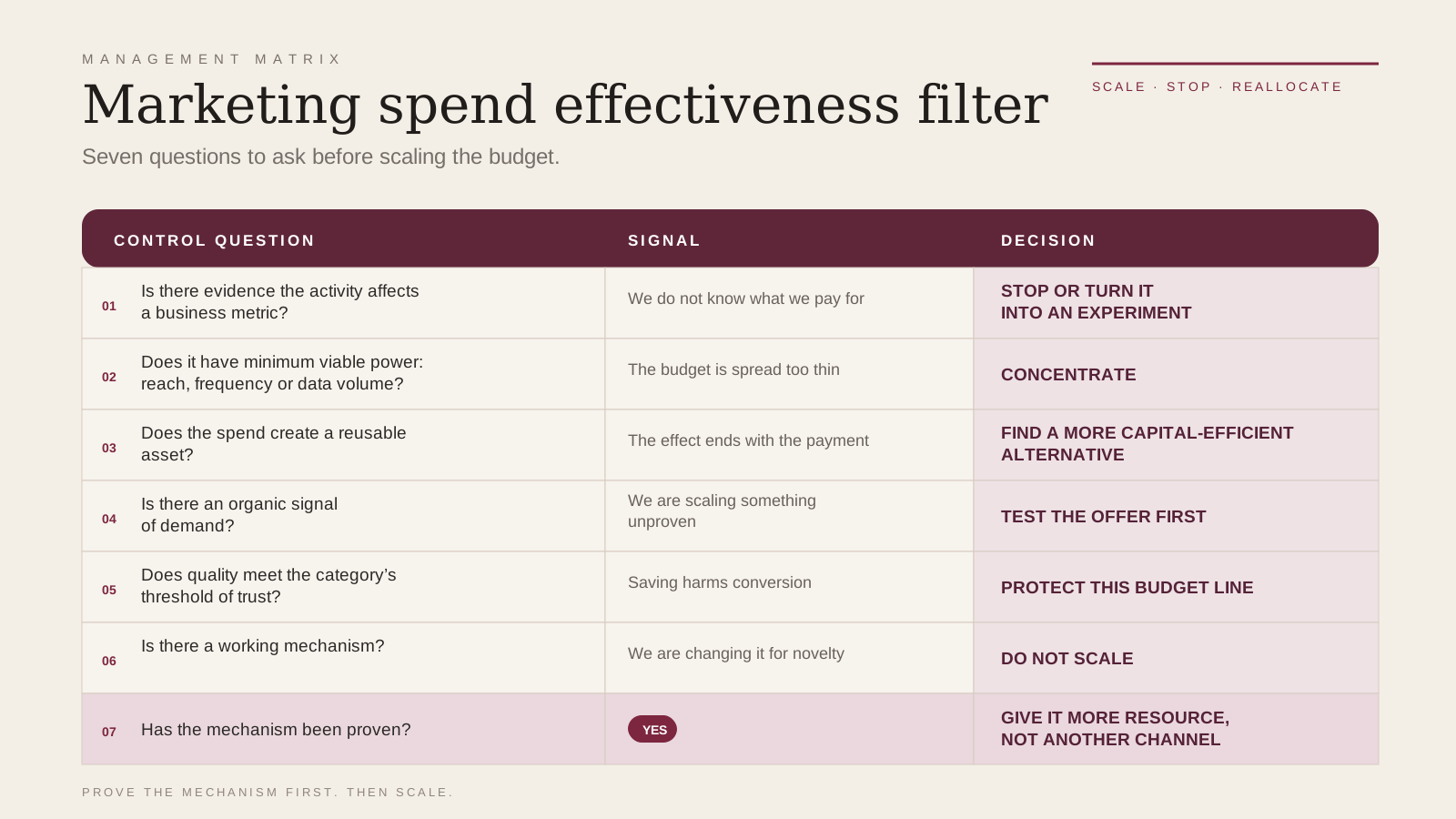
If the marketing budget fell by 40% tomorrow, I would not cut every line proportionally. I would test each activity against seven questions: can it show an effect on a business metric, does it have minimum viable power, does it create a reusable asset, is demand proven, does it protect the category’s trust threshold, and is there already a working mechanism?
The logic is simple: prove the mechanism first, then scale it. Stop, reallocate or turn into an experiment anything the business cannot yet explain why it is paying for.
What to measure without an analytics department
A small business does not need a dashboard of forty metrics. It needs a chain that connects communication to money: input signal → qualified action → sale → customer economics.
Not reach alone, but reach among the right people or at least a credible proxy. Not leads alone, but the proportion of qualified leads. Not CPA alone, but gross profit after acquisition. Not repeat purchase alone, but its timing and margin. Not merely ‘this channel produced sales’, but incrementality wherever it can be approximated.
Most importantly, know in advance what decision a number will change. A metric that changes no decision is reporting, not management.
Conclusion: a budget is not a strategy
A small business genuinely has less room for error. That does not mean its marketing must become a weak copy of a large brand’s marketing.
Constraint forces the choices large organisations often postpone: one market instead of five; one provable barrier instead of a list of channels; one strong platform instead of endless content generation; one experiment with a stopping rule instead of ‘let’s try’; one working mechanism to scale instead of a constant hunt for novelty.
Money buys speed, reach, production and access. It does not remove the need to make the right choice. With a small budget, the quality of choice becomes the main source of efficiency.
Strong communication without a large-brand budget is not the art of doing things for free. It is the ability to see where one pound must replace ten — and where no amount of ingenuity can replace the pound itself.
A professional strategy of scarcity begins not with ‘what can we do for almost nothing?’ but with three other questions: which constraint is stopping the business from growing now; what is the smallest set of actions capable of changing it; and what will we consciously refuse to do until we have enough resource to do it with sufficient power?
This is no longer marketing on a shoestring. It is capital allocation.
Sources and research
- Nielsen — Annual Marketing Report 2024
A survey of almost 2,000 global marketers: 70% prioritise performance; 84% feel confident measuring ROI, while only 38% measure digital and traditional media together.
- Kantar × WARC — creative effectiveness and ROMI
Research into creative effectiveness: the strongest creative generated more than four times the profit; creative quality is one of the most important controllable drivers of advertising profitability.
- WARC — What’s Working in Low-Budget Marketing 2025
Creative quality, earned media, PR, partnerships and mental availability as key levers for constrained budgets.
- WARC × CreativeX — content production and media support, 2026
Analysis of more than 633,000 ads: content production rose 29%, average media support per ad fell 15%, and 93% of ads received less than $10,000 in support.
- LinkedIn B2B Institute — The 95–5 Rule
Research with the Ehrenberg-Bass Institute on mental availability, future demand and the acquisition of new buyers.
- LinkedIn B2B Institute × IPA — Binet & Field
Research into the balance between long-term brand building and short-term sales activation in B2B.
- WARC — The Effectiveness Code
An analysis of 4,863 effectiveness cases: the importance of duration, media support and avoiding excessive campaign fragmentation.